
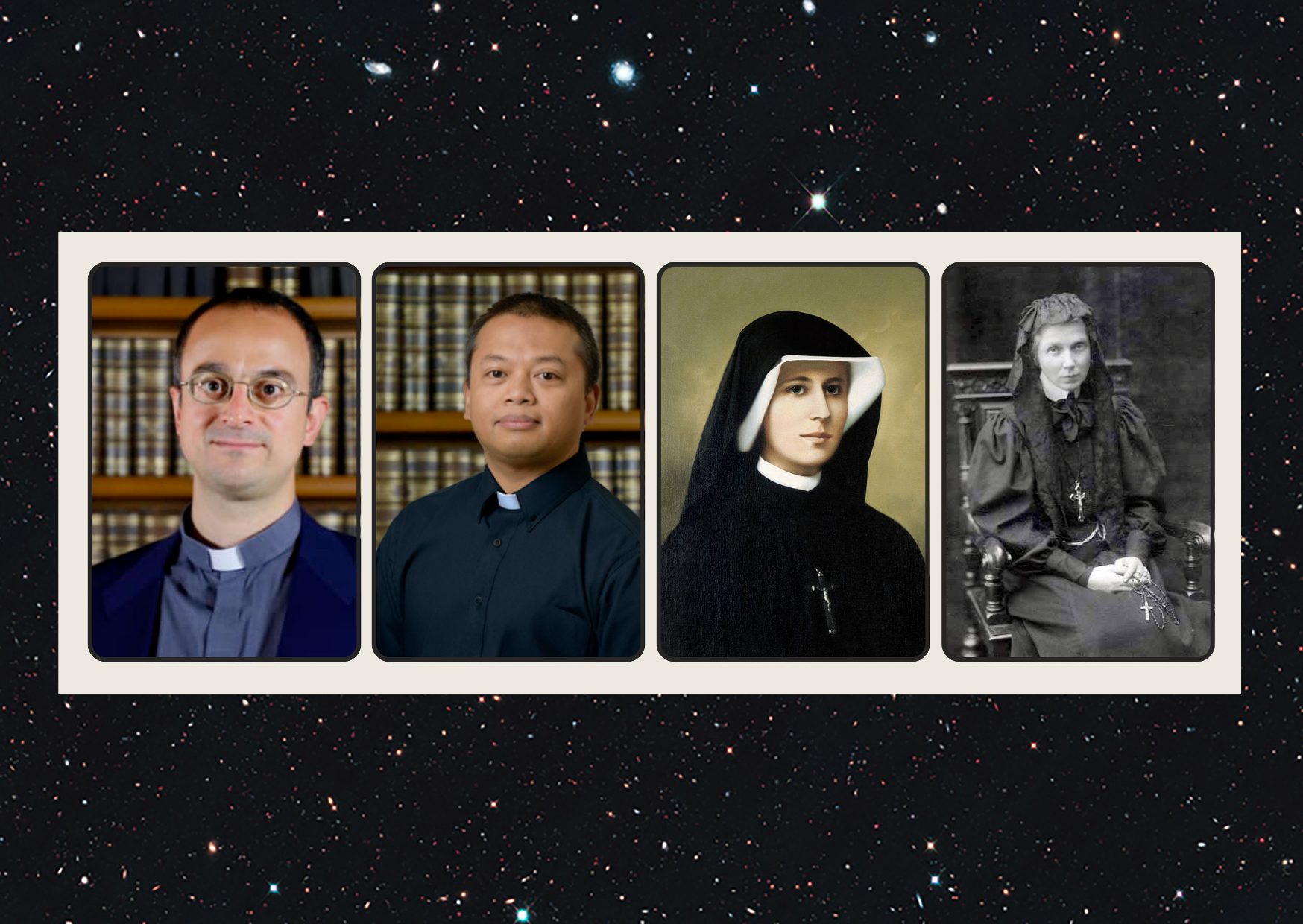
The latest bulletin of IAU’s(International Astronomical Union) Working Group for Small Body Nomination has some exciting news for the scientists at the Vatican Observatory. Several asteroids co-discovered by Vatican Astronomer Fr. Richard P. Boyle SJ along with his long-time collaborator K. Černis (from Vilnius, Lithuania) using the Vatican Observatory telescope VATT on top of Mount Graham have received official names. Among the names featured are those of Don Matteo Galaverni and Fr. Bayu Risanto SJ, staff members of the Vatican Observatory. Furthermore, other asteroids discovered at the Vatican Observatory by Černis and Boyle have been named after St. Faustina Kowalska and St. Ursula Ledóchowska, another polish nun who founded the Congregation of the Agonising Heart of Jesus. Furthermore, another asteroid was named after a Jesuit García Alabiano (1549–1624) a Spanish Jesuit theologian who taught at the University of Vilnius. This list adds to the nearly 40 odd asteroids named after Jesuits.
The list of the recent asteroids named are:
(591000) Galaverni = 2013 AB189
Discovery: 2012-12-08 / K. Černis, R. P. Boyle / Mount Graham / 290
Matteo Galaverni (b. 1981) is an Italian diocesan priest and physicist. He works in theoretical cosmology, including the cosmic microwave background, dark matter, dark energy, and alternative theories of gravity. Matteo is also interested in the relationship between faith, philosophy, and science.
(752403) Bayurisanto = 2015 PZ114
Christoforus Bayu Risanto (b. 1981) is an Indonesian Jesuit priest whose research focuses on meteorology. He improves weather forecasts by combining physical-based models with data assimilation, especially in areas with limited observation data. His work utilizes moisture data from GPS meteorology alongside traditional datasets from weather stations.
(798737) Faustina = 2012 VZ114
Discovery: 2012-11-13 / K. Černis, R. P. Boyle / Mount Graham / 290
Faustina Kowalska (1905–1938) was a Polish nun and mystic known for her visions of Jesus and the message of Divine Mercy. Her diary, Divine Mercy in My Soul, inspired the Divine Mercy devotion practiced worldwide. She was canonized in 2000 and is honoured as the “Apostle of Divine Mercy.”
(798772) Ledochowska = 2012 WH32
Discovery: 2012-11-20 / K. Černis, R. P. Boyle / Mount Graham / 290
Ursula Ledóchowska (1865–1939) was a Polish nun. She founded the Congregation of the Agonizing Heart of Jesus, whose mission is to proclaim the love of the Heart of Jesus, primarily through education and teaching, as well as service to the most needy and the wronged. She was canonized in 2003
(763533) Alabiano = 2012 EN6
García Alabiano (1549–1624) was a Spanish Jesuit theologian who taught at the University of Vilnius, where he served as its second rector from 1585 to 1592. After acting as adviser to cardinal Jurgis Radvila and returning to Spain following the cardinal’s death in Rome, he held two terms as rector of the College of the Immaculate Conception in Saragossa.
How do asteroids get their names?
The asteroid naming process is managed by the International Astronomical Union’s Working Group for Small Body Nomenclature.
When an asteroid is first discovered, it is given a ‘provisional designation’ based on the date of discovery. For the asteroid 2021 FE40, for example, ‘2021’ indicates the year of discovery. The letter ‘F’ indicates the half-month of discovery within that year. ‘A’ indicates the first half of January, ‘B’ indicates the second half of January, and so on, with the letter ‘I’ skipped to avoid confusion with the number 1. ‘F’, therefore, corresponds to the 6th half-month of the year – the second half of March.
‘E40’ indicates how many other asteroids had already been discovered during this half-month. The first 25 discoveries in a half-month receive the letters A—Z (the letter ‘I’ is again skipped). The next 25 are assigned A1—Z1, the next 25 receive A2—Z2, then A3—Z3 etc. 2021 FE40 was therefore the 1005th asteroid discovered in the second half of March 2021.
Once the asteroid’s orbit is well known and its future trajectory can be reliably predicted, it receives a permanent number. Roughly 850 000 of the 1.3 million known asteroids have received permanent numbers: (1) Ceres was the first to be numbered, while (810657) 2021 FE40 was the 810 657th.
Once an asteroid has received its permanent number, its discoverers are invited to propose a name to replace the provisional designation. The proposed name is reviewed by the Working Group and must follow certain IAU guidelines. Names should be no longer than 16 characters and typically written as one word.
Asteroid names must be pronounceable in at least one recognised language, and they must not be offensive. The names of personal pets, commercial products, and recent political or military figures are generally not allowed.
Some classes or families of asteroid have naming traditions: Jupiter’s Trojan asteroids are named after figures associated with the Trojan War, for example, while the Centaur family of asteroids are named after mythological centaurs.
Once approved, the asteroid becomes known by its official name, written as ‘(number) Name’, like the recently named (763533) Alabiano.

Blog Categories
Recent Posts
Connect
Subscribe
Please insert your API key for mailchimp.